
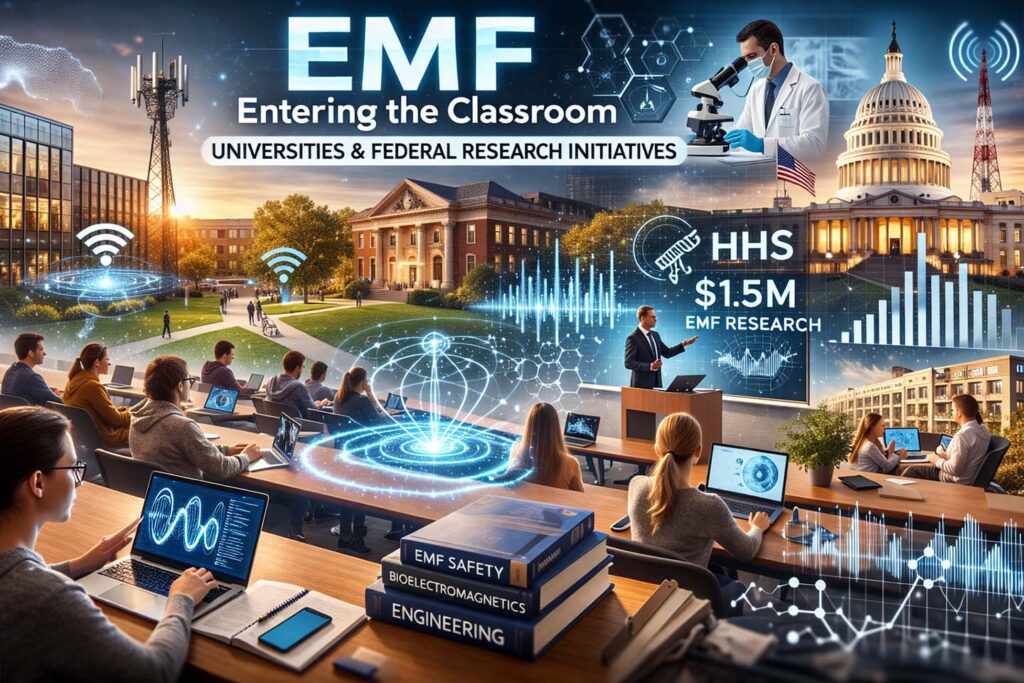
Electromagnetic Fields (EMFs) are no longer a fringe topic.
What’s becoming increasingly clear is that EMF awareness is entering the mainstream — not just through wellness conversations, but through academia and now even federal research initiatives.
In recent years, I’ve noticed a growing shift: more colleges and universities are beginning to introduce EMF-related education into their curriculum, particularly in programs tied to environmental health, building biology, engineering, public health, and occupational safety.
That’s a big deal.
Because it signals something important:
EMF exposure is no longer viewed as a theoretical issue — it’s increasingly recognized as a modern environmental variable worth understanding.
Federal Momentum: HHS Allocates Funding for EMF Research
What’s even more notable is that this academic shift is now being mirrored at the federal level.
In early 2026, the U.S. Department of Health and Human Services (HHS) announced a formal initiative to study potential health effects tied to cellphone radiation and electromagnetic exposure.
Under the direction of HHS Secretary Robert F. Kennedy Jr., the department has reportedly allocated approximately:
$1.5 million toward this EMF/cellphone radiation research effort.
While modest compared with broader NIH budgets, this represents a meaningful signal:
The federal government is now investing resources into updated EMF science in a modern wireless world.
This adds a powerful layer to the educational trend: students entering fields like environmental health, biomedical research, engineering, and public policy may soon be joining a workforce where EMF science and safety are not optional topics — but active areas of research, policy, and regulation.
A Growing Academic Trend: EMF in Higher Education
We live in a hyper-connected world:
Cell phones. Wi-Fi routers. Smart devices. Bluetooth. Wearables. 5G infrastructure.
EMFs are now a constant byproduct of modern life.
Universities are responding by asking deeper questions:
- How do electromagnetic fields interact with biological tissue?
- What are safe exposure thresholds?
- How should buildings and systems be designed in wireless-dense environments?
- What does EMF literacy look like for the next generation of engineers and health professionals?
This shift is measurable.
One major course-aggregation platform currently lists:
101 courses under “Electromagnetic Fields.”
That’s not a fringe category — it’s an emerging educational lane.
Where EMF Shows Up in University Curriculum (Real Examples)
EMF-related education is now appearing across several disciplines:
- Environmental & Occupational Health: Radiation Safety
Some universities now teach EMF exposure under the umbrella of non-ionizing radiation safety.
- Colorado State University offers ERHS 515 – Non-Ionizing Radiation Safety (2 credits), explicitly covering radiofrequency sources such as Wi-Fi networks and cell phones.
This is a major signal that EMFs are increasingly treated as an environmental health variable.
- Bioelectromagnetics: EM Fields + Human Biology
Bioelectromagnetics is one of the fastest-growing academic bridges between physics and health sciences.
- Ohio State University lists ECE 6011 – Bioelectromagnetics, an interdisciplinary graduate course.
- Georgia Tech offers ECE 8803 – Bioelectromagnetics: Fundamentals and Applications, focused on electromagnetic interaction with biological tissues.
- Purdue University teaches Computational Bioelectromagnetics, applying modeling to EM exposure and tissue response.
This is where EMF becomes less about speculation — and more about applied science.
- Electromagnetic Compatibility (EMC): Industry Standards & Infrastructure
EMC coursework is increasingly important as our world becomes more electronically dense.
- University of Washington published a syllabus for Electromagnetic Compatibility (Spring 2025).
- University of Kansas offers EECS 611 – Electromagnetic Compatibility, covering shielding, emissions, grounding, and regulatory standards.
- European universities such as Uppsala University and Linköping University also offer EMC coursework tied to compliance and system design.
Even outside of health discussions, this is EMF literacy becoming foundational.
- Core Engineering & Professional Certificates
Electromagnetic fields are also a core pillar of electrical engineering education.
- NC State University lists ECE 540 – Electromagnetic Fields.
- Texas A&M offers an online graduate certificate in Electromagnetic Fields and Microwave Circuit Design (15 credits).
This confirms EMF is not optional — it is central to modern engineering training.
What This Means for All of Us
The takeaway isn’t fear.
The takeaway is awareness.
When universities begin teaching EMF across engineering, biomedical science, and public health — and when HHS begins allocating funding to research it — it tells us one thing:
This topic is moving into the mainstream.
The next generation of professionals will be EMF literate by default.
And that will shape the future of:
- Building design
- Technology infrastructure
- Health research
- Consumer awareness
- Wellness and recovery environments
Final Thought
We are living in one of the most wireless-dense environments in human history.
Education and research are now catching up.
And that shift is worth paying attention to.
A Scientific Lens Going Forward
At TRU47®, we view EMF not through speculation or fear, but through the lens of emerging research, environmental health awareness, and responsible inquiry.
As universities expand coursework in bioelectromagnetics, electromagnetic compatibility, and non-ionizing radiation safety — and as federal agencies begin allocating new resources toward updated research — it is clear that EMF is becoming an increasingly important area of modern scientific study.
The next chapter of this conversation will be shaped by:
- Improved measurement and exposure modeling
- Better-designed infrastructure and building standards
- Ongoing biomedical and public-health research
- A more informed and scientifically grounded public dialogue
We believe education and evidence-based awareness are essential as society continues to evolve in an increasingly wireless world.
To explore more of our research and perspective, visit TRU47®:
Edward Bugniazet
Rye Strategic Partners, LLC, CEO/Founder
Chairman of TRU47®