The AI Technology Stack Every Organization Should Understand
Across most organizations, AI adoption today looks like this: individual contributors using generic tools for drafts, summaries, and research. Useful. But nowhere near the opportunity.
The gap between “our teams use AI tools” and “we have built an intelligent capability” is the gap between a starting point and a competitive transformation.
Here is the full technology landscape — and the strategic question each capability answers for your organization:
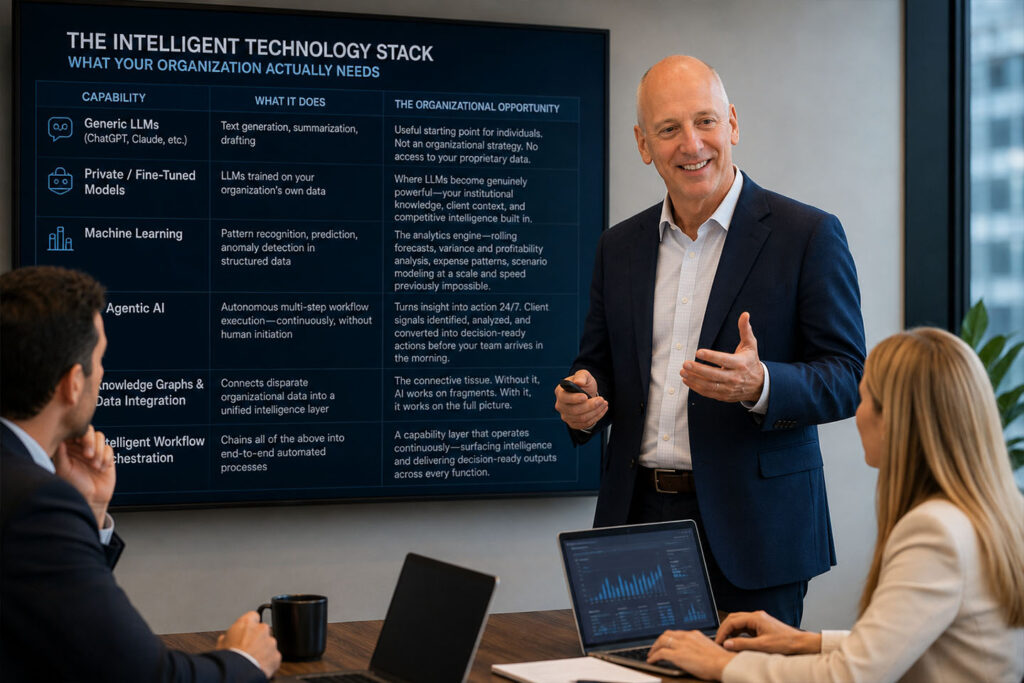
THE INTELLIGENT TECHNOLOGY STACK — WHAT YOUR ORGANIZATION ACTUALLY NEEDS
Capability | What It Does | The Organizational Opportunity |
Generic LLMs (ChatGPT, Claude, etc.) | Text generation, summarization, drafting | Useful starting point for individuals. Not an organizational strategy. No access to your proprietary data. |
Private / Fine-Tuned Models | LLMs trained on your organization’s own data | Where LLMs become genuinely powerful — your institutional knowledge, client context, and competitive intelligence built in. |
Machine Learning | Pattern recognition, prediction, anomaly detection in structured data | The analytics engine — rolling forecasts, variance and profitability analysis, expense patterns, scenario modeling at a scale and speed previously impossible. |
Agentic AI | Autonomous multi-step workflow execution — continuously, without human initiation | Turns insight into action 24 hours a day. Client signals identified, analyzed, and converted into decision-ready actions before your team arrives in the morning. The organization that never stops working — even when your people do. |
Knowledge Graphs & Data Integration | Connects disparate organizational data into a unified intelligence layer | The connective tissue. Without it, AI works on fragments. With it, it works on the full picture. |
Intelligent Workflow Orchestration | Chains all of the above into end-to-end automated processes | A capability layer that operates continuously — surfacing intelligence and delivering decision-ready outputs across every function. |
This is the capability that changes the revenue equation most fundamentally. Insight that arrives in a report next Friday is interesting. Insight that triggers a decision-ready action at 11pm Tuesday — before your competitor has seen the signal — is a competitive advantage.
The strategic question is not “should our organization use AI?” The question is: which combination of these capabilities, applied to which decisions, will unlock the most value from our teams’ expertise and our organization’s data? That requires a strategy — not a tool adoption.
Three Decisions That Move This Forward
→ Audit your organization’s current AI tool usage honestly — map what your teams are actually using against the technology stack above and identify the capability gaps most relevant to your strategic priorities. → Assess your organization’s data foundation — the value of every capability in this stack depends on the quality, connectivity, and governance of your underlying data. Commission an honest assessment before committing to a deployment strategy. → Engage your CIO or technology leadership as a strategic partner — not a procurement gatekeeper. The organizations that move fastest embed technology leadership in the strategic conversation from the beginning, not after the business case is already written.
The Expert Ascends. The AI Executes. #TheExpertAscends #AI #MachineLearning #AgenticAI #ExecutiveLeadership